Lawn
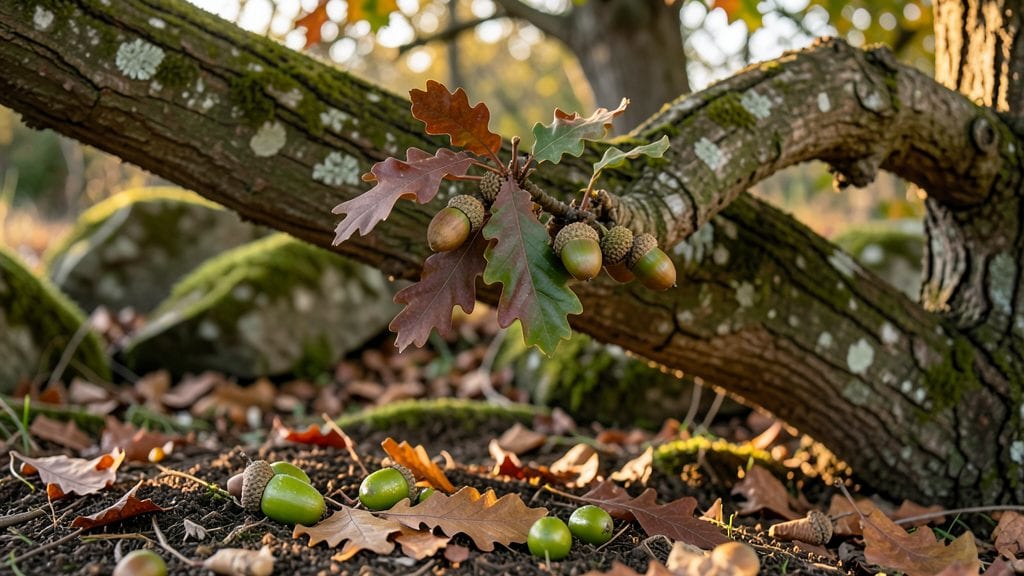
Identifying oak seed pods means looking for acorns—those distinctive cup-like structures that vary dramatically by species. White oak acorns have smooth, rounded caps, while red oak acorns feature scaly, spiky caps, and their size, shape, and leaf attachment patterns make each type unique.
These seed pods aren't just visually striking—they're nature's ID badges for oak trees. 🌳 The cap shape alone can tell you whether you're dealing with a white oak (sleek and rounded) or a red oak (rough and jagged).
I've seen gardeners use acorn shape as a quick way to identify trees before checking bark or leaves, especially in mixed forests where multiple oak species grow side by side.
The key is paying attention to subtle details like cap texture and how the acorn attaches to its stem—these variations are what make oak identification both a science and an art.
What's fascinating is how these traits evolved differently across species. White oak acorns, for example, take longer to mature but resist pests better, while red oak acorns mature faster but are more vulnerable to insects.
This explains why you might find more white oak acorns on the ground in late fall—they're simply taking their time to drop. For anyone learning to spot oak seed pods, I recommend starting with these two common types before tackling the more obscure varieties like live oaks or bur oaks.
💡 In This Article
- Oak Seed Pod Anatomy and Species-Specific Traits
- Field Guide for Spotting Oak Seed Pods in Nature
Oak seed pod anatomy and species-specific traits
The acorn's three-part structure—cap, nut, and stem—serves specific ecological functions. The cup-like cap (technically called the cupule) protects the nut during development and often determines species identification. White oak caps are smooth with shallow grooves, while red oak caps have pronounced, overlapping scales that feel like tiny shingles.
The nut itself ranges from 0.5 to 2 inches long, with white oak acorns typically being larger and more rounded, while red oak acorns are smaller with a more elongated shape.
Leaf attachment patterns provide another clue: white oak leaves have rounded lobes with bristle-tipped points, while red oak leaves feature pointed lobes with no bristles. The stem (or peduncle) varies too—white oak acorns have a shorter, stouter stem, whereas red oak stems are longer and more slender.
These differences aren't just cosmetic; they reflect evolutionary adaptations. For instance, white oak acorns take 18-24 months to mature, developing thicker shells that deter squirrels and insects, while red oak acorns mature in just 6-12 months but are more vulnerable to pests.
Seasonal variations play a crucial role in identification. Acorns typically appear in late summer to early fall, but timing differs by species. White oak acorns often cling to branches until October or November, while red oak acorns drop as early as September.
This timing explains why you might find red oak acorns scattered on the ground in late summer but still see white oak acorns clinging to trees when red oaks have already shed theirs.
The bark also provides context: white oaks have smooth, light gray bark with shallow furrows, while red oaks develop deeper, more pronounced ridges as they age.
Let's compare four common oak types using measurable traits:
- White Oak: 1.5-2 inch acorns with smooth, rounded caps; leaves with 5-9 lobes per leaf
- Red Oak: 0.75-1.25 inch acorns with scaly caps; leaves with 7-9 pointed lobes
- Live Oak: 1-1.5 inch acorns with elongated, pointed caps; evergreen leaves with 2-4 inches length
- Black Oak: 0.75-1.25 inch acorns with shallowly grooved caps; leaves with 5-7 bristle-tipped lobes
The acorn's internal structure also reveals species traits. White oak acorns contain 30-50% tannins, making them bitter and less palatable to animals, while red oak acorns have 10-20% tannins and are more readily consumed. This chemical difference explains why wildlife often targets red oak acorns first.
The hilum (the scar where the acorn attaches to the stem) is another diagnostic feature—white oak hilums are more elongated, while red oak hilums appear more circular when viewed from above.
What most people don't realize is how these traits adapt to local climates. In drier regions, acorns tend to be smaller with thicker shells to conserve moisture, while in wetter areas, they're larger and more fleshy.
For example, live oak acorns from coastal areas often have a thicker cap to protect against salt spray. Understanding these adaptations helps explain why acorn traits can vary even within the same species across different geographic regions.