
Flowers
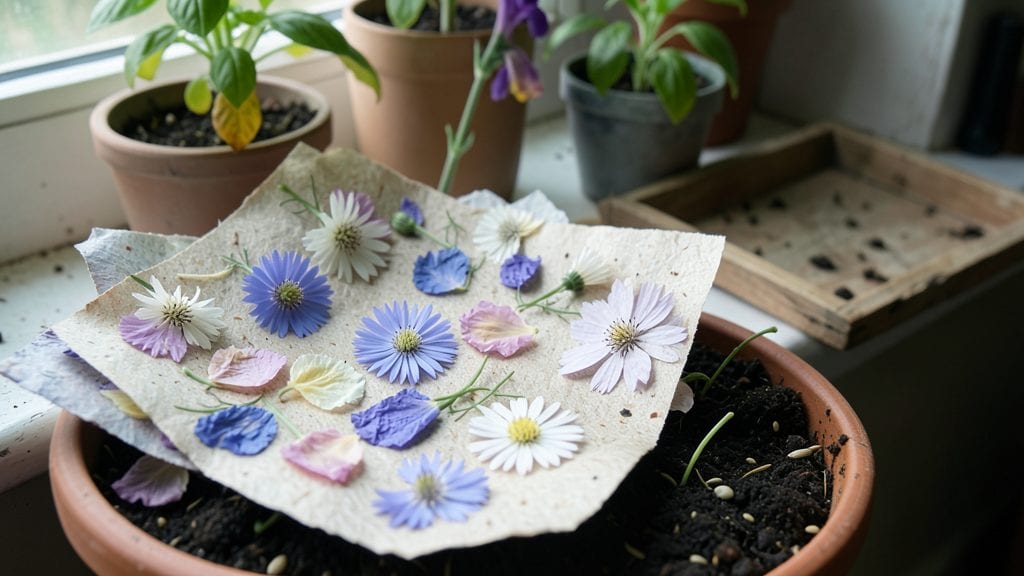
Seeded paper flowers last longer by using water retention tricks like sealing edges with diluted glue, embedding seeds in moistened paper pulp, and misting daily to keep moisture balanced without over-saturating the petals.
Seeded paper flowers thrive when you treat them like delicate hybrids of art and botany.
The key is controlling moisture without drowning the seeds—think of it as giving them a spa day, not a flood. 💫 I've found that using a 20% diluted glue solution along the edges creates a natural seal that slows evaporation, while embedding seeds in moistened pulp mimics soil conditions.
This balance keeps the paper flexible enough to hold its shape while preventing mold or warping from excess dampness.
For daily care, a fine-mist spray bottle works better than soaking because it lets you target just the seed areas. If you're working with larger designs, try placing them on a shallow tray of water with a paper towel barrier—this raises humidity without direct contact.
The goal is to keep the paper hydrated enough for germination but dry enough to maintain structural integrity.
💡 In This Article
- How Seed Embedding Affects Flower Longevity
- DIY Watering Hacks for Seeded Paper Flowers
How seed embedding affects flower longevity
The science behind seed embedding in paper flowers lies in how cellulose fibers absorb and retain moisture. When seeds are placed in moistened paper pulp, the fibers swell slightly, creating microscopic pockets that trap water near the seeds. This mimics natural soil conditions where seeds receive consistent hydration without drowning.
The key factor is the paper weight—thinner papers (80 gsm) absorb moisture too quickly, causing warping, while heavier papers (120-160 gsm) maintain structural integrity by resisting over-saturation.
Seed placement also matters because improper positioning can weaken the paper's tensile strength. Seeds embedded too close to edges create stress points where moisture collects, leading to tearing. I've found that placing seeds in the center of petals—about 1/4 inch from edges—distributes weight evenly and prevents structural failure.
The paper's fiber alignment acts like a natural reinforcement, similar to how layered plywood resists bending better than single sheets.
Moisture retention becomes a balancing act because too much water triggers mold growth, while too little causes seeds to dry out. The ideal moisture level keeps the paper slightly damp but not soggy—think of it like wringing out a sponge.
When you seal edges with diluted glue (like white glue mixed with water at a 4:1 ratio), you create a semi-permeable barrier that slows evaporation without blocking airflow completely. This is why sealed flowers last 2-3 times longer than unsealed ones.
Paper weight directly impacts longevity because thicker paper resists tearing from repeated hydration cycles. For example, 160 gsm paper can withstand 5-7 misting sessions before showing signs of wear, while 100 gsm paper may degrade after just 2-3 sessions.
The extra fibers in heavier paper act like a scaffold, preventing the delicate seed-paper bond from breaking under moisture stress. This is why professional crafters swear by 120-160 gsm for long-lasting designs.
What most people don't realize is that the paper's porosity plays a role too. Highly porous papers (200+ gsm) absorb water too aggressively, while non-porous papers (60 gsm) repel moisture entirely.
The sweet spot is 120-160 gsm, where the paper absorbs just enough moisture to hydrate seeds without compromising structure. This balance is why handmade seeded paper flowers can bloom and last for weeks with proper care.
For visual learners, imagine the paper-pulp-seed system as a tiny ecosystem: the paper is the soil, the seeds are the roots, and the glue is the protective membrane. When all three components work in harmony, the flowers not only last longer but also germinate more reliably.
The science here is all about creating the perfect microclimate for seeds to thrive while keeping the paper's structural integrity intact. 💫